
What Is a Real Estate Debt Fund? A Plain-English Guide for Accredited Investors
A real estate debt fund pools investor capital to make loans secured by property. How they work, what they pay, how they differ from equity funds, and who they suit.

What a real estate debt fund actually is
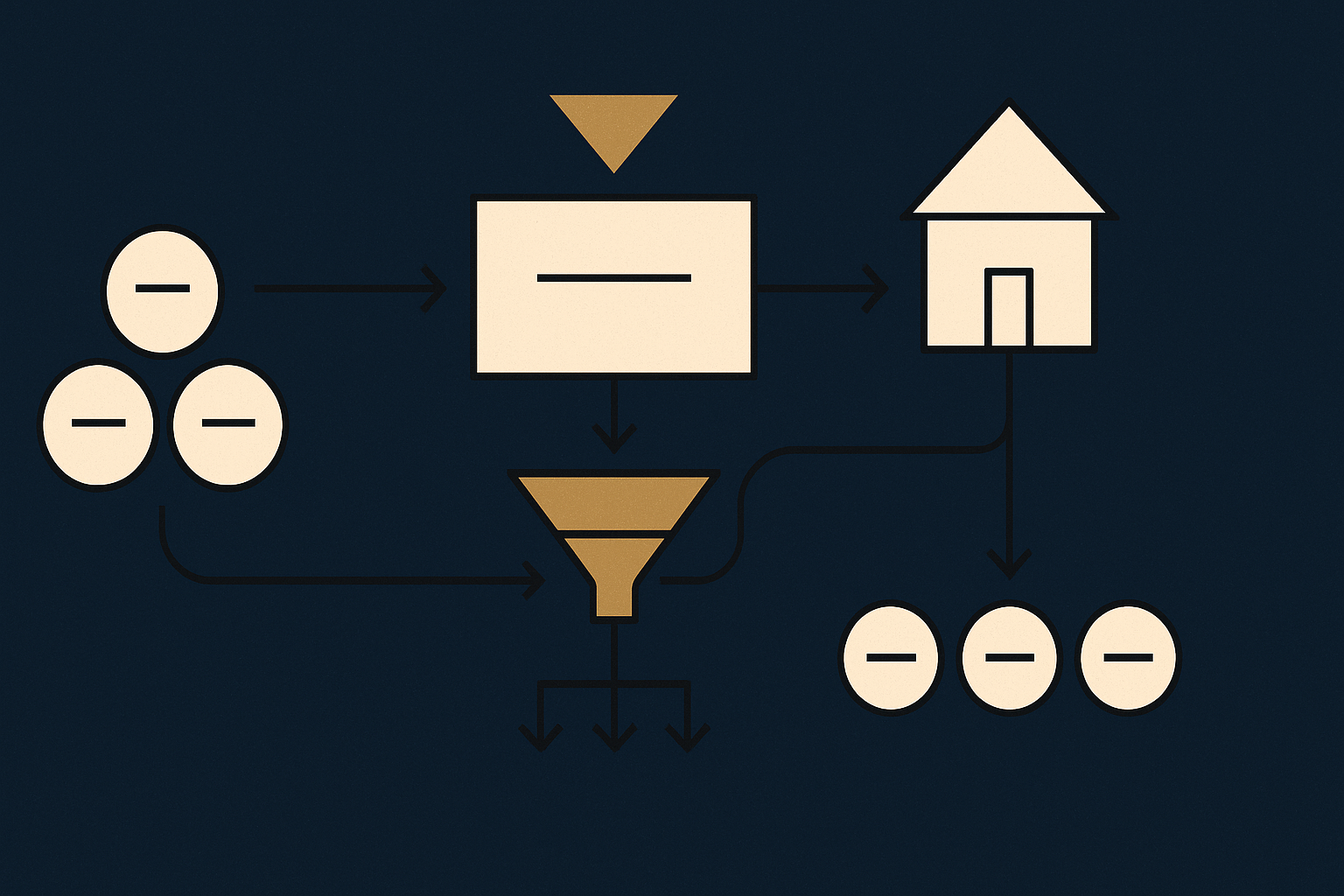
Strip the vehicle down and there are four moving parts.
Investors subscribe. You sign a subscription agreement, your accredited status is verified, and you wire capital into the fund entity. You own a membership interest in the fund, not an interest in any single loan.
The fund lends. The manager underwrites borrowers, mostly real estate operators who need money faster or on different terms than a bank will provide, and advances principal against a promissory note plus a recorded deed of trust.
Borrowers pay interest. These loans are typically interest-only with principal due in a balloon at maturity, repaid when the borrower sells or refinances.
Investors receive distributions. The fund collects interest, pays its expenses and fees, and distributes cash on a set schedule, commonly monthly or quarterly.
Here is the whole cycle in one picture.
The loan lifecycle underneath that picture runs on a shorter clock than most investors expect.
Application — borrower, property, budget and exit plan.
Underwriting — value, loan-to-value, credit, experience and a title search.
Closing — note signed, deed of trust recorded, title policy issued naming the lender, funds wired.
Servicing — monthly interest collected; construction draws released after inspection.
Exit — either (a) payoff at sale or refinance, with principal and final interest returned to the fund, or (b) default, leading to a workout, deed in lieu, or foreclosure and sale of the collateral.
You are the bank, not the landlord
This is the clearest framing available, and it is worth sitting with.
You do not own property. You own the right to be repaid, secured by property. The borrower owns the asset, takes the risk of the renovation running over, carries the cost of taxes and insurance, and keeps whatever profit is left after paying you.
That cuts both ways. If the borrower buys a house for $300,000, spends $70,000 and sells for $520,000, your return does not change. You earned your contract rate. If that same borrower runs $60,000 over budget and sells for $380,000, your return still does not change, as long as the loan is repaid. You sit ahead of the borrower's equity, so their mistake comes out of their money before it comes near yours.
The bank framing also tells you what your job is as an investor. A landlord evaluates a market. A lender evaluates a downside. The question is not how good the deal is. The question is what the collateral is worth if the borrower disappears tomorrow and the fund has to sell it in a hurry.
Where a debt fund sits in the capital stack
The capital stack is the ordering of everyone with a claim on a property. Order is everything, because when a deal fails the money stops somewhere in that list and everyone below it gets nothing.
| Position (top = paid first) | Paid order | Risk | Typical return profile |
|---|---|---|---|
| Senior debt (1st lien) — the debt fund's position | 1st | Lowest | Contractual rate only, no upside |
| Junior / 2nd lien debt | 2nd | Higher | Higher contractual rate, no upside |
| Mezzanine debt | 3rd | Higher still | Rate plus sometimes an equity kicker, often secured by equity interests rather than the property itself |
| Preferred equity | 4th | High | Preferred rate, capped upside |
| Common equity | Last | First to absorb loss | Unlimited upside; the sponsor and their LPs take the first dollar of loss |
A first-lien debt fund sits at the top. In exchange for being paid first, you accept a return capped at the contract rate. The common equity at the bottom takes the first loss in exchange for everything above the loan balance. Neither position is better in the abstract. They are different trades, and you should know which one you are making.
What these funds lend on
Private real estate debt funds are generally lending for business purposes on short timelines. The common collateral types:
Fix and flip. A one to four unit residential property bought below market, renovated and resold. Six to twelve months.
Bridge loans. Interim financing while a borrower stabilises a property or waits for a bank refinance to close.
Ground-up construction. Funded through a draw schedule against inspected progress, underwritten on as-completed value.
Small multi-family. Two to twenty units, often value-add, too small or too fast for a bank process.
Entitled land. Zoning and utilities in hand. Raw dirt produces no income and sells slowly, so responsible lenders advance much less against it.
These are business-purpose loans to entities, not consumer mortgages to homeowners. That distinction changes the regulatory framework the lender operates under.
How investors get paid
Most funds pay through a distribution waterfall. Cash collected from borrowers goes through a fixed order of priority.
Fund operating expenses, servicing and debt service on any fund-level borrowing.
The preferred return to investors, expressed as an annual percentage.
The manager's asset management fee.
A split of whatever remains between investors and the manager.
The preferred return is the number most people fixate on. It is a priority, not a promise: it tells you who gets paid first, not that anyone gets paid. It can be cumulative, meaning unpaid amounts accrue and must be caught up later, or non-cumulative, meaning a shortfall in one period is simply gone. That one word changes the value of the term materially.
Here is what a preferred return looks like as arithmetic.
Illustrative only. Not a projection, and not a representation of any actual result.
| Your capital | 8% preferred return, annual | Per quarter |
|---|---|---|
| $100,000 | $8,000 | $2,000 |
| $250,000 | $20,000 | $5,000 |
| $500,000 | $40,000 | $10,000 |
Now the part sponsors skip. The rate the borrower pays is not the rate you receive, and you should understand where the difference goes. According to Private Lender Link, the average Houston hard money interest rate in the second quarter of 2026 was 9.84%, on an average loan size of about $570,000 across 247 loans. A fund lending at roughly that level, plus origination points, has a gross yield in the low double digits. Out of that gross yield come loan servicing, legal and foreclosure costs, fund audit and tax preparation, administration, the manager's asset management fee, and the drag of any capital sitting uninvested between loans. The investor distribution is what survives that list.
Cash drag is part of that list. When a loan repays, the money sits in the fund's account until the next loan closes, earning close to nothing. A manager who lets capital sit is quietly cutting your yield. A manager who lends it out too fast to avoid that is doing something worse.
What a debt fund does NOT give you
Say this part out loud before the good part.
No depreciation. Interest income from a debt fund is generally ordinary income, with no depreciation deduction sheltering it, because you do not own the building. For a high-bracket investor that is a real cost relative to an equity deal.
No appreciation. If the collateral doubles in value you receive your contract rate and nothing more. That upside belongs to the borrower.
No 1031 exchange. A debt fund interest is not like-kind real property.
No equity upside, ever. The best possible outcome is that every loan pays exactly as agreed. The distribution of outcomes is capped on the right and open on the left, which is why credit underwriting is the whole job.
If what you want is a tax-advantaged, appreciating, exchangeable real estate position, a debt fund is the wrong vehicle and you should stop reading here.
Debt fund vs the alternatives, in one table
| Private debt fund | Mortgage REIT | Equity syndication | Direct private lending | Bond fund | |
|---|---|---|---|---|---|
| Return source | Loan interest and points | Loan interest, often levered | Rent and sale proceeds | Loan interest and points | Coupon and price change |
| Position | Usually first lien | Varies, often levered paper | Common equity, last paid | First lien, your choice | Unsecured or agency paper |
| Liquidity | Low, lock-up and notice | Daily if listed | Very low, deal-length | None until payoff | High |
| Daily price swings | No mark to market | Yes, with equity beta | No | No | Yes |
| Upside | Capped at the contract rate | Some, with volatility | Uncapped | Capped | Limited |
| Diversification | Many loans in one position | Many loans | One property | One or two loans | Many issuers |
| Your workload | Read documents, then none | None | Read documents, then none | Substantial and ongoing | None |
| Tax reporting | K-1 | 1099 | K-1 | 1099 or Schedule C | 1099 |
Each comparison deserves more room than a table row. The long versions are linked at the end.
Who these funds are actually for
Four kinds of investor keep showing up on the other side of the table.
People who want contractual income rather than a story. They have owned equity deals and know what a capital call feels like. They would rather hold the senior position and be paid on a schedule.
Self-directed IRA and solo 401(k) holders. Ordinary income inside a retirement account does not carry the tax friction it carries outside one, and an open-ended fund can hold a position for years without forcing a taxable event.
Landlords who are tired. Not of real estate. Of tenants, turnovers, insurance renewals and 11pm phone calls. Lending is the same asset class with the operations removed.
People who just sold something. A business, a building, a practice. They hold a large cash balance and no interest in becoming an operator again. The common thread is that all four want property as collateral rather than as a job.
How to evaluate one
Six questions, in the order that filters fastest.
What is the lien position, in writing, on every loan? First lien is a different asset from a blended first and second book.
What is the weighted loan-to-value, and against what value? As-is and after-repair values are not the same number, and 70% against an optimistic ARV is not conservative.
What is the manager's loss history, and is it their record or audited fund performance? Confusing the two is a warning sign.
What is the fee stack end to end? Asset management fee, points, servicing fee, and who keeps the points and any default interest.
What are the liquidity terms exactly? Lock-up, notice period, processing frequency, per-quarter caps, and any right to suspend redemptions.
Does the fund use leverage, and on what terms? A note-on-note facility raises returns in good conditions and accelerates losses in bad ones.
As one worked set of answers: Matador Note Fund 1 LLC is a Texas limited liability company that originates first-lien loans on Texas real property only, targets a 65 to 75% weighted loan-to-value with an 85% maximum, runs a 24 month lock-up followed by written request with 90 days' notice processed quarterly at up to 25% of balance, and charges a 2% annual asset management fee on invested capital. The preferred return is 8% per year, non-cumulative, paid quarterly before any manager profit share, with 60/40 of excess distributable cash in favour of investors above it. Target total return is 8 to 12% annually, a target rather than a projection. The offering is made under Rule 506(c) to accredited investors only, $50,000 minimum, $5,000,000 maximum committed equity. Whether those terms suit you is your call, and the Private Placement Memorandum governs.
The honest risk summary
Illiquidity is the real cost. A lock-up means your money is committed. Notice periods, quarterly processing and per-quarter caps exist because the fund's assets are loans that cannot be sold on a Tuesday. If you might need the capital, this is the wrong place for it.
Borrowers default. Some percentage always does. Foreclosure costs money and time, the property may need work the borrower never finished, and recovery is rarely the full accrued balance plus costs. A first lien at a conservative LTV turns most defaults into a delay rather than a loss. The word is most.
Collateral values can fall faster than the equity cushion. A 70% LTV loan survives a 30% decline on paper and rather less in practice, once you add selling costs, carrying costs and the discount a distressed sale attracts.
Leverage cuts both ways. A fund borrowing against its own loan book improves investor returns while everything performs and magnifies the damage when it does not.
You are underwriting one manager. In an equity deal you can inspect the building. In a debt fund, the asset is the manager's credit discipline, their willingness to say no, and their competence when a loan goes sideways. That is not a diversifiable risk and no structure removes it.
Frequently asked questions
Q: What is a real estate debt fund?
A: A real estate debt fund is a pooled investment vehicle that uses investor capital to make loans secured by real property. Investors are paid from the interest and fees borrowers pay, not from rent or from the sale of buildings. The fund holds the note and a recorded lien on the collateral, and it can foreclose if the borrower fails to repay. Most private debt funds are sold only to accredited investors.
Q: How do real estate debt funds make money?
A: The fund lends at a rate higher than what it pays investors. A loan might carry a 10 to 12 percent interest rate plus origination points. Out of that gross yield the manager pays servicing, legal, audit and administration costs, takes an asset management fee, and distributes what remains to investors under the fund waterfall. The difference between the loan rate and the investor distribution is the spread.
Q: Are real estate debt funds safe?
A: No investment that pays a meaningful yield is safe, and a debt fund is not an exception. A first-lien position and a conservative loan-to-value ratio reduce the chance that a single default costs investors principal, but they do not remove it. Debt fund capital is illiquid, subject to lock-ups, and exposed to borrower default, collateral value declines and the quality of one manager's judgment.
Q: What is the minimum investment in a real estate debt fund?
A: Private real estate debt funds commonly set minimums between $25,000 and $250,000, with $50,000 and $100,000 being the most frequent. Matador Note Fund 1 LLC has a $50,000 minimum. Minimums exist partly for administration cost and partly because managers want a subscriber base they can service. Some funds will accept a smaller amount at the manager's discretion, and the offering documents will say so.
Q: Do you need to be accredited to invest in a real estate debt fund?
A: For a private fund offered under Regulation D, almost always yes. A fund using Rule 506(c) may advertise publicly but may sell only to accredited investors, and it must take reasonable steps to verify accredited status independently rather than accept a self-certification. Some non-traded public vehicles accept non-accredited investors, but they are a different structure with different disclosure and different fees.
If you want the long-form material rather than a sales call, join the investor letter or download the investor package and read it at your own pace. No one will phone you.
Important disclosures. This article is for informational purposes only and is not an offer to sell or a solicitation of an offer to buy any security. Any offer is made only through the Private Placement Memorandum, Operating Agreement and Subscription Agreement of Matador Note Fund 1 LLC, which govern in all cases and should be read in full, including the risk factors. Interests are offered only to accredited investors as defined in Rule 501 of Regulation D, pursuant to Rule 506(c); accredited status must be independently verified. Real estate debt investments involve significant risk, including possible loss of principal. The 8% preferred return is non-cumulative and is payable only from available distributable cash at the manager's discretion; it is not guaranteed. The 8–12% figure is a target objective, not a promise or projection of results. Targeted returns are not guarantees of future performance, and past performance is not indicative of future results. Figures describing prior lending are the manager's own lending record and are not audited fund performance. Nothing here is legal, tax or investment advice. Matador Lending LLC is not a registered investment adviser.
What to read next
Money page: how the fund works